Led Zeppelin IV: four players, two guests and no title
The fourth Led Zeppelin album carries no name on the cover, and its credits are short: four band members plus a pianist and a singer who each appear on one song. The detail is in who plays what on each track.
By SongTrace · Published 25 November 2026 · 4 min read
The record
Wikipedia describes the untitled fourth album by Led Zeppelin, commonly called Led Zeppelin IV, as released by Atlantic Records on 8 November 1971 and produced by the guitarist Jimmy Page. MusicBrainz agrees on the release date and label, and credits Page as producer with Peter Grant as executive producer.
According to Wikipedia it was recorded between December 1970 and February 1971, mostly at Headley Grange, a country house in Hampshire, using the Rolling Stones Mobile Studio and the engineer Andy Johns. The sessions began at Island Records’ studios on Basing Street in London, overdubs were added at Island in February, and Page mixed at Sunset Sound in Los Angeles before remixing the album in July.
The album has no official title. Wikipedia says the sleeve shows no text and that each member chose a symbol, so catalogues have used names such as Four Symbols and The Fourth Album. MusicBrainz lists it as “[Led Zeppelin IV]”, in square brackets, the convention for a title that is not printed on the release.
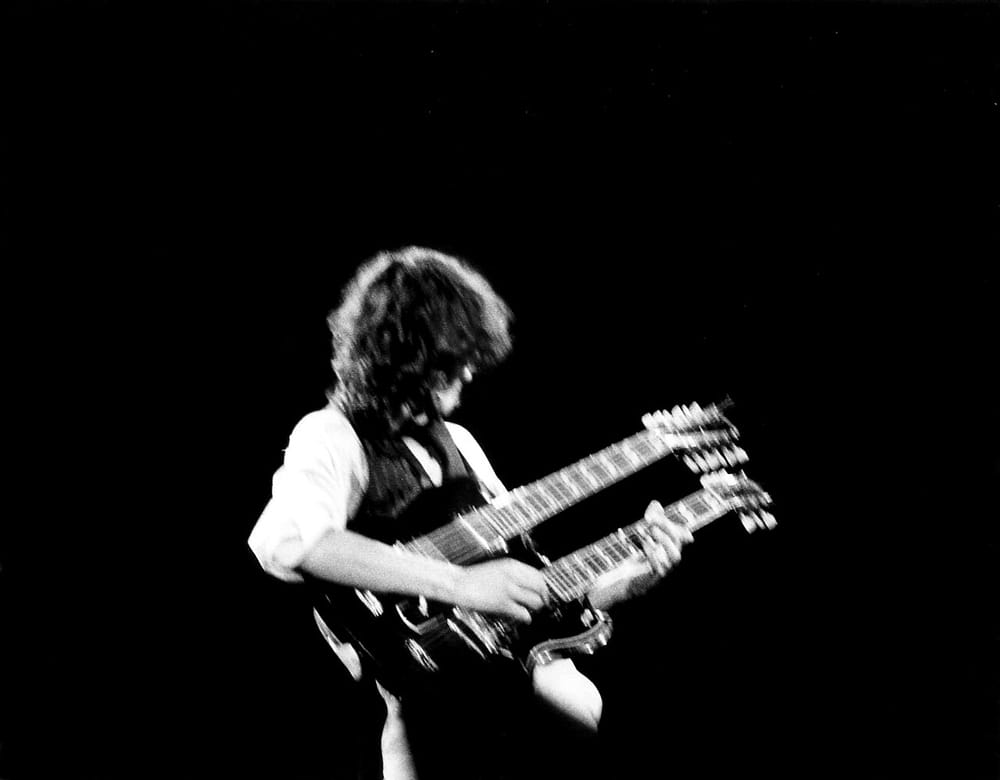
Who played what
Wikipedia’s personnel list, based on a book by Guesdon and Margotin, gives:
- Jimmy Page: electric and acoustic guitars, mandolin on “The Battle of Evermore”, and production.
- Robert Plant: vocals, and harmonica on “When the Levee Breaks”.
- John Paul Jones: bass, electric piano, mandolin, recorders and synthesiser.
- John Bonham: drums.
- Sandy Denny: duet vocals on “The Battle of Evermore”.
- Ian Stewart: piano on “Rock and Roll”.
Andy Johns is credited with engineering and mixing, and George Chkiantz with mixing. MusicBrainz attributes the mix of “The Battle of Evermore” to Chkiantz and the other seven songs to Johns.
What changes from track to track
A short list of names hides a lot of switching. Wikipedia says “The Battle of Evermore” was written by Page on a mandolin borrowed from Jones, and that Denny, of Fairport Convention, was the only female voice on a Led Zeppelin recording. Stewart, who was assisting with the sessions, is credited on “Rock and Roll”, a song that Wikipedia says grew out of a jam.
On “Stairway to Heaven” the basic backing track has Bonham on drums, Jones on electric piano and Page on acoustic guitar, and Jones also plays recorders in the introduction. “Misty Mountain Hop” has Jones on electric piano, and on “Four Sticks” he plays a synthesiser, while Bonham plays the drum pattern with four sticks.
Wikipedia also says Bonham’s opening drums on “When the Levee Breaks” were recorded in the entrance hall of Headley Grange, with two microphones hung above a staircase. The room is part of the sound, but no credit names it.
What this teaches about reading credits
- A record can have no title. Search by artist and song, and expect the album to appear under more than one name.
- The instrument list on a band album is per song. Jones is credited with bass and keyboards, but not every instrument is on every track.
- Guests are credited for one song. Denny and Stewart are on one track each, so the album-level credit alone says nothing about where.
- Databases can differ. MusicBrainz’s release credits for this album do not list Stewart, while Wikipedia does, so check more than one source.
Look it up
Search a song from the album, such as The Battle of Evermore, and compare the credits with the list above. For another album from the same year, read Blue: who played on Joni Mitchell’s 1971 album, and for the roles on the page, Producer, engineer, arranger: what the credits mean.
Sources
The facts in this story were checked against the pages below (the Wikipedia pages are in English). Credits can differ between sources, so for anything important compare with the original release.
Share this story
Keep reading
 Photo: Matt Gibbons · CC BY 2.0Blue: one writer-producer, a few guests, and credits that differ by source4 min read
 Photo: Tony Hisgett · CC BY 2.0Rumours: a five-piece band, and what the credits say track by track4 min read
 Photo: Ksks2424 · CC BY-SA 4.0Producer, engineer, arranger: what the credits really mean5 min read